

Understanding the Entering Class of 2025: A HERI Perspective
June 11, 2026 | Higher Education Research Institute (HERI), UCLA
The findings from the 2025 CIRP Freshman Survey (TFS), the latest installment of higher education’s longest-running study of incoming college students, are now available. For over six decades, HERI has tracked the experiences, aspirations, and concerns of entering college students, and now in its 61st administration, through this work, we gain a clearer understanding of where American higher education is heading.
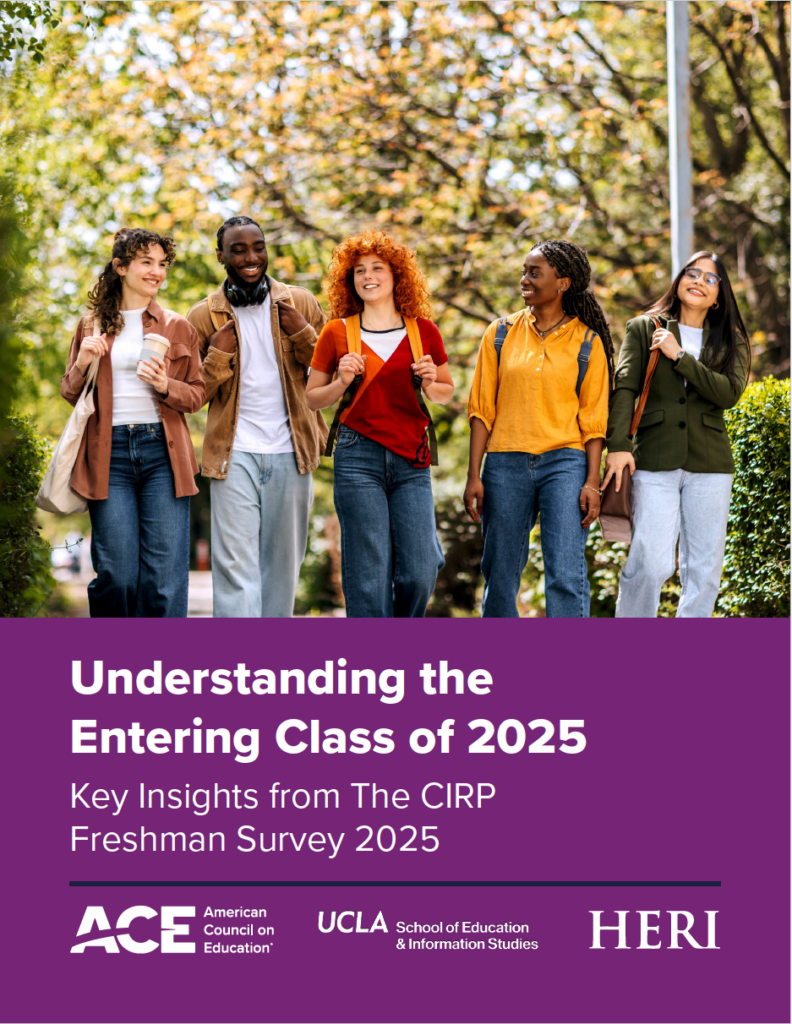
In collaboration with the American Council on Education (ACE), we are proud to share Understanding the Entering Class of 2025: Key Insights from The CIRP Freshman Survey 2025. Based on responses from more than 17,000 incoming students across 44 four-year colleges and universities, this year’s findings reveal a student population navigating complex challenges while maintaining strong educational intentions.
What This Data Tells Us
While the findings reflect participating institutions rather than national representation, the breadth of this sample provides higher ed administrators, educators, researchers, and policymakers meaningful insights into today’s incoming students. Here are the patterns that stood out to our team:
Students See College Value Beyond Employment
First-generation students particularly demonstrate sophisticated understanding of higher education’s returns: 78 percent cited better employment as important, yet nearly as many identified learning and personal interests as key motivations. This suggests ROI thinking extends well beyond financial metrics alone.
Financial Pressures Remain Central
With 54 percent of students expressing concerns about paying for college, economic anxiety clearly shapes enrollment decisions and campus expectations. These pressures disproportionately affect low-income and Black and Hispanic students; patterns we’ll suggest institutions to address through targeted support systems.
Long-Term Educational Trajectories Are Already Forming
Perhaps one of our most significant findings involves graduate-level planning. While first-generation students are less likely than peers to expect a master’s degree as their highest credential (30.5% vs. 38.9%), nearly two-thirds anticipate pursuing education beyond a bachelor’s degree. Many expect professional degrees in medicine, law, or other fields—demonstrating that these students view their undergraduate experience as part of extended educational and career pathways.
Political Identity Relates to Geographic Considerations
This year’s survey also captured important data about how students weigh political context when selecting colleges. We found that students who identify politically as middle of the road were less likely to consider the politics or legislation of the state where a college is located as an important factor in their choice of college. Only about one-third (33.5 percent) of these students reported this as somewhat or very important, compared to 40.1 percent of far right/conservative students and 54.7 percent of liberal/far left students. This suggests that ideological polarization may be shaping geographic enrollment choices, with students at the political extremes placing greater weight on state policy environments.
Mental Health Challenges Warrant Institutional Attention
The rates of pre-college mental health concerns documented this year are striking, particularly among women (90.8% reporting anxiety) and nonbinary/gender non-conforming students (97.2%). These numbers create clear imperatives for institutions to strengthen wellness infrastructure before students even arrive on campus.
Why Longitudinal Data Matters
As Director of CRESST at UCLA and home of HERI, Li Cai noted: “The longitudinal data we collect on entering college students simply has no equal; it provides an irreplaceable wealth of knowledge for higher ed administrators and researchers striving to understand the evolving landscape of American higher education.”
That sixty-year span allows us to track generational shifts in ways cross-sectional studies cannot. When we see nearly two-thirds of first-generation students already planning for graduate-level pathways, or when we document stark mental health disparities across identity groups, we’re not just reporting statistics—we’re revealing patterns that have implications for curriculum design, support services, and institutional strategy.
This collaboration with ACE brings HERI’s research infrastructure together with ACE’s policy expertise. As Hironao Okahana, ACE’s managing researcher and chief of planning and impact, observed: “Even amid concerns about college affordability and mental health pressures, many students are entering college with strong aspirations… The findings also highlight the financial and personal challenges many students face before arriving on campus and the importance of tailoring institutional support and services to meet their needs.”
Our hope is that these insights empower institutions to move beyond assumptions and tailor their approaches to meet the genuine financial, academic, and well-being needs of today’s diverse entering class. We continue this vital work because understanding students’ starting points—complete with their hopes, anxieties, and ambitions—is the foundation for effective higher education practice.
The 2025 CIRP Freshman Survey was administered by HERI at UCLA CRESST.
